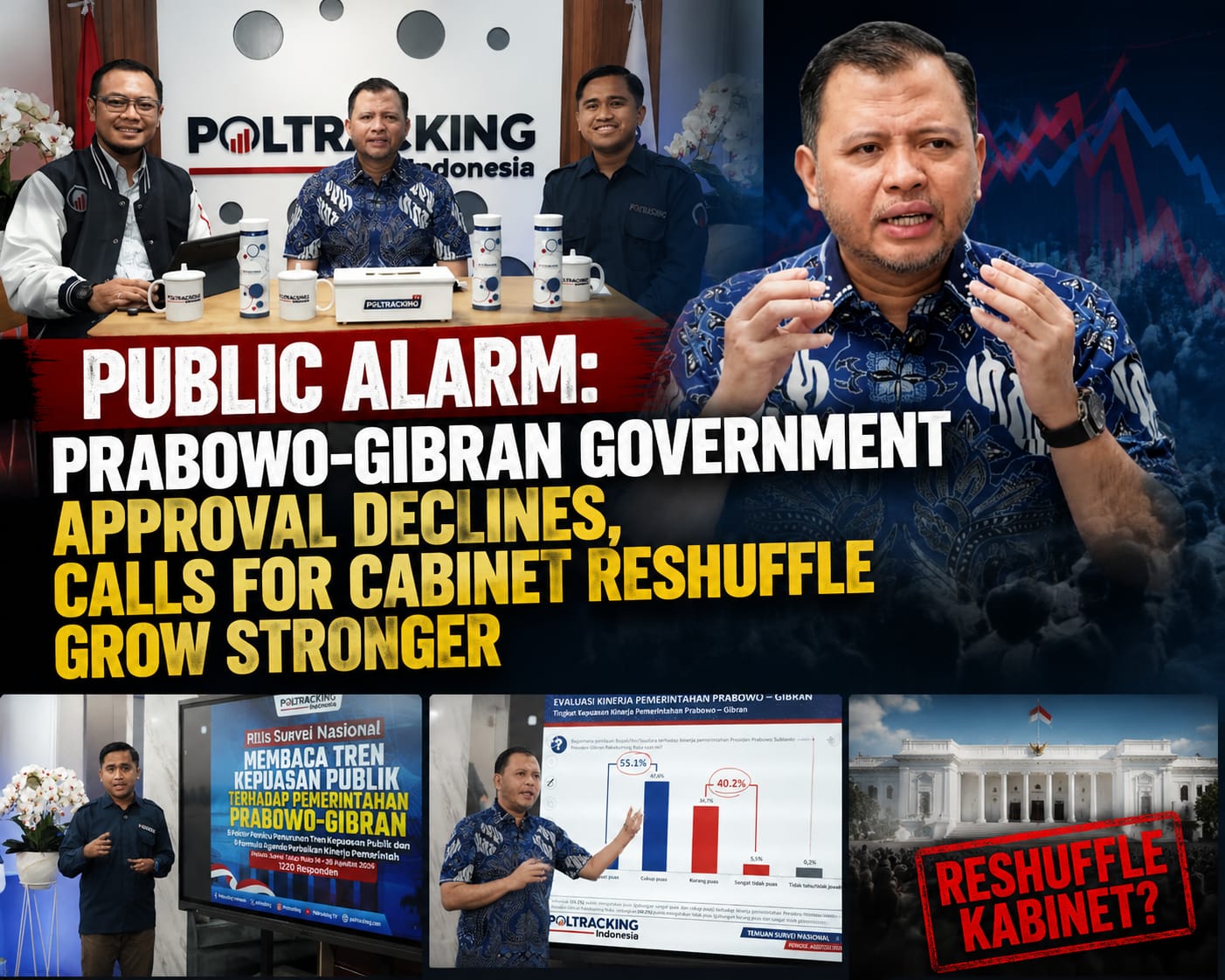
Jakarta, screenshootnews.com. -— The government of President Prabowo Subianto and Vice President Gibran Rakabuming Raka still holds public trust at 63.2 percent. However, warning signs have emerged as public satisfaction with the government’s performance has declined to 55.1 percent.
A national survey by Poltracking Indonesia shows that economic pressures are the main factor influencing public sentiment. Rising prices of basic necessities, increasing household expenses, and employment challenges have become the biggest concerns among citizens regarding government performance.
The face-to-face national survey was conducted from August 14–20, 2026, involving 1,220 respondents across 38 provinces. It used a stratified multistage random sampling method, with a margin of error of ±2.9 percent at a 95 percent confidence level.
Basic Commodity Prices and Declining Purchasing Power Become Major Concerns
Poltracking recorded that 44.3 percent of respondents considered high prices of basic necessities as the main problem currently facing society. Meanwhile, 55.6 percent said essential goods had not become affordable over the past month.
Economic pressure is also reflected in household conditions. As many as 62.5 percent of respondents said their household expenses are now higher compared with the previous year.
In the employment sector, 57.3 percent of respondents believe the government has not succeeded in significantly reducing unemployment.
Government Priority Programs Face Public Scrutiny
The Free Nutritious Meals (MBG) program, one of the government’s flagship initiatives under the Prabowo-Gibran administration, is widely recognized by the public, with an awareness level of 93.9 percent.
However, its implementation remains a challenge. A total of 49.2 percent of respondents expressed dissatisfaction with the program, while 46.4 percent said they were satisfied.
Regarding the continuation of MBG, public opinion remains divided. Around 44.6 percent of respondents believe the program should not continue, while 42.1 percent want it to be maintained.
The Merah Putih Village Cooperative (KDMP) program is also facing a challenge of public trust. Although 76.9 percent of respondents are aware of the program, 55.6 percent remain uncertain that it can sustainably improve village communities’ welfare.
Public Pressure for Cabinet Evaluation Intensifies
Government ministers have also come under scrutiny. Public satisfaction with the performance of ministers and government officials stands at only 47 percent.
Meanwhile, 51.9 percent of respondents believe President Prabowo should reshuffle the cabinet to improve government performance.
The sectors most frequently considered in need of evaluation are the economy, with 30.8 percent, followed by law, human rights, immigration, and corrections, with 22 percent.
The main reason behind public demands for a cabinet reshuffle is the perception that some ministers’ performances have not met expectations.
Economy, Law, and Corruption Become Major Government Challenges
Beyond economic issues, law enforcement and corruption eradication remain major concerns. These sectors are among those receiving the lowest public satisfaction ratings.
In terms of democracy, most citizens still believe that a critical opposition is necessary. A total of 58.5 percent of respondents said opposition parties are important to monitor and balance the government.
Poltracking identified five main factors contributing to the decline in public satisfaction: economic pressure, weak implementation of priority programs, the performance of some ministers and government communication, public perceptions of law enforcement and corruption issues, and weakening checks and balances.
Although public trust remains a political asset for the Prabowo-Gibran administration, the survey serves as a warning that the government must accelerate efforts to improve the people’s economy, ensure the effectiveness of flagship programs, and strengthen the quality of governance.